
When people talk about the cost of living, they usually mean the price of food, fuel and energy. For many households in Barnet, though, the biggest bill each month is the rent or the mortgage. We think building more new homes in the borough is part of the answer. It will not end the squeeze on its own, and it takes time, but it helps in three ways: it adds to the supply of homes, it cuts running costs, and it creates local work.
What housing costs in Barnet
The Office for National Statistics (ONS) puts the average private rent in Barnet at £1,949 a month in August 2026, 3.3% higher than a year earlier. The average house price in the borough was £601,000 in July 2026, a provisional figure. Across London, the average home cost 10.6 times average full-time earnings in 2025, the highest ratio of any region. Renting offers little relief. In the year to March 2024, a London household renting privately on a median income would have needed 41.6% of its gross income for an average rent. The ONS counts rent as affordable at 30% of income or less.
Pressure on temporary accommodation
When rents are out of reach, more households turn to the council for help. Barnet Council's Temporary Accommodation Reduction Plan 2026–2030 reports that the number of households in temporary accommodation rose by a third in two years, from 2,202 in June 2023 to 2,945 in June 2025. The plan notes that only around 650 social homes become free to let in a typical year, and that in June 2025 households in the lower-priority bands faced an average wait of just over 19 years. It names the cost-of-living crisis among the causes, alongside high private rents and a shortage of affordable homes, and sets out how the council intends to reduce its dependence on temporary accommodation.
More homes, over time
No single development brings rents down, and we would not pretend otherwise. But it is widely accepted that building more homes eases prices and rents over time. A 2023 research note from the Greater London Authority (GLA) described a "broad consensus" in academic and policy research that extra supply puts downward pressure on prices and rents in the long run, while stressing that the short-term and local effects are far less certain. It also explains how new homes help people who never live in them: each household that moves into a new home leaves another one free, and the chain of moves that follows spreads the benefit through the market, including to households on lower incomes. The note is candid that in the UK, rising demand has usually outweighed the effect of new supply. We read that as a reason to build more, not less, and to include social and affordable homes, which help lower-income households most directly.
Barnet is expected to do a large share of that building. The London Plan 2021 sets the borough a ten-year target of 23,640 net new homes, and the Mayor's draft of a new London Plan, published in July 2026, proposes 32,849 for the ten years from 2027/28: the largest target of any London borough. Growth on that scale brings real trade-offs. New homes need school places, GP surgeries, transport and good design, and any building on the Green Belt deserves careful scrutiny. In our view, those are reasons to plan well rather than to build less.
Cheaper to heat
The second benefit gets less attention: new homes cost much less to run. Research published in February 2026 by the Home Builders Federation (HBF), the housebuilders' trade body, and Octopus Energy found that a 90-square-metre home rated A or B for energy efficiency costs about £1,574 a year to run, compared with £1,995 for a home rated D: a difference of £421 a year. In the year before the report, 87% of new-build homes given an Energy Performance Certificate were rated A or B, against 5% of existing homes. Official data points the same way. The ONS found that homes built after 2012 had a median energy efficiency score of 84, compared with 69 for homes in England as a whole. For a household on a tight budget, a difference of around £400 a year matters.
Local work, local wages
The third benefit is closer to home for us. Building creates jobs, and when the people doing the work live nearby, more of their wages are likely to be spent nearby too, in local shops and businesses. At AGL we recruit most of our workforce locally, from Barnet and North London, and we employ most of them directly. So when we build in the borough, much of what the work pays in wages goes to people who live in and around it. We also try to play our part in the borough beyond our own sites. We make regular financial donations to the community and social causes of Barnet Homes, which manages the council's housing, and our teams carry out work for Barnet Homes free of charge.
Our new build in Barnet
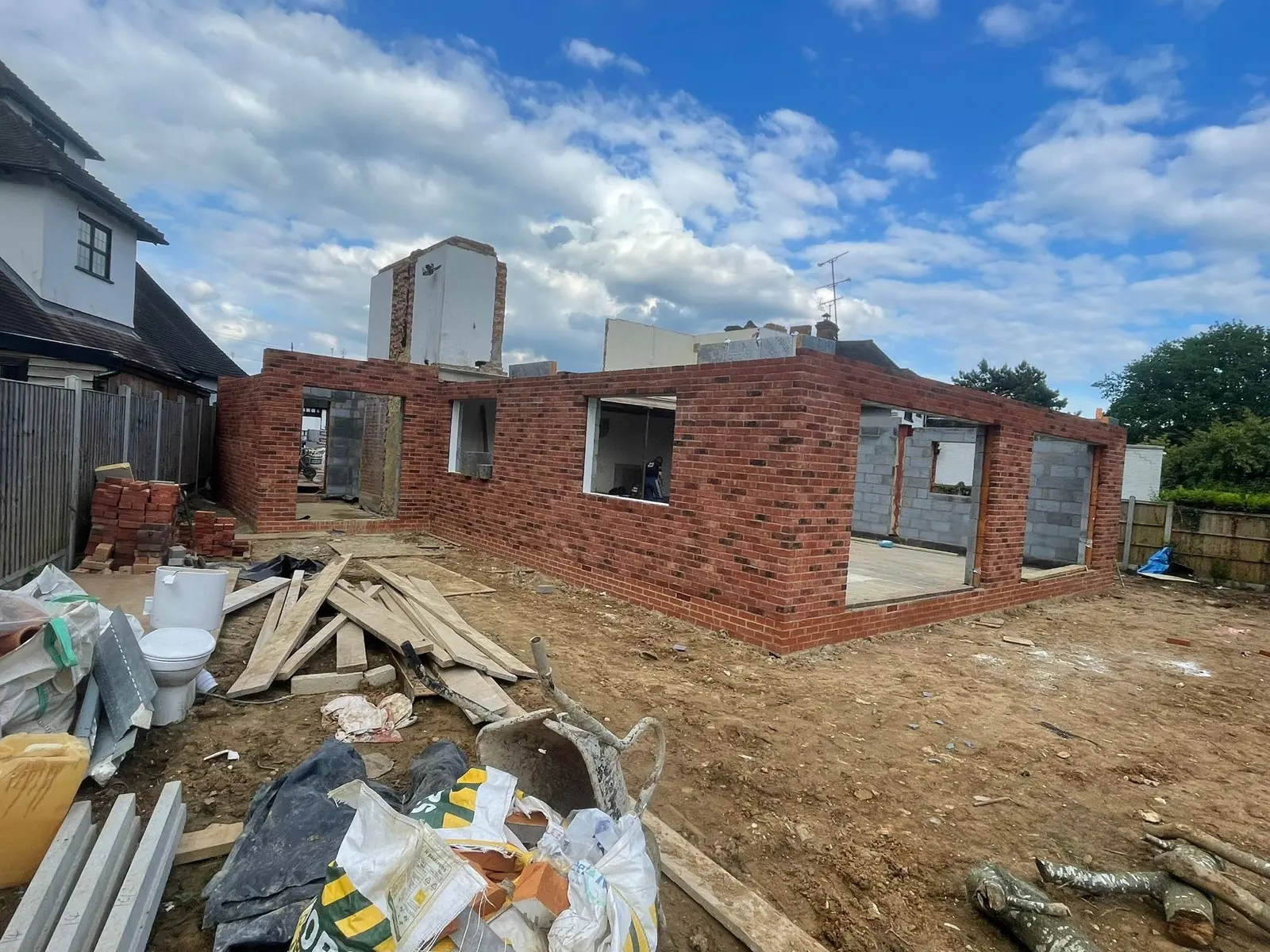
Our own recent new build in Barnet is a small example. On a residential plot in the borough, we built from the groundworks up, in facing brick with a blockwork inner leaf. One building does not change the borough's housing numbers. But the homes Barnet needs will be delivered site by site, by builders large and small, and we think it matters that many of the people doing that work live locally.
What would help
We are builders, not policymakers, but from where we stand four things would help:
- More homes of every tenure, including social and affordable homes, which do the most for households on lower incomes.
- Running costs counted as part of affordability, so that what a home costs to heat sits alongside its price or rent.
- Schools, health services and transport planned alongside new homes, not after them.
- Local jobs and training built into new schemes, so that building work benefits the people who live nearby.
None of this will solve the cost-of-living crisis. Wages, benefits, interest rates and energy prices matter too. But housing is one cost that more building can ease over time, in rent and in running costs alike. That is why, in our view, Barnet should keep building: well, locally, and with the people who need homes in mind.
Sources
- Office for National Statistics — Housing prices in Barnet (2026)
- Office for National Statistics — Housing affordability in England and Wales: 2025 (2026)
- Office for National Statistics — Private rental affordability, England, Wales and Northern Ireland: 2024 (2025)
- London Borough of Barnet — Temporary Accommodation Reduction Plan 2026–2030 (2025)
- Greater London Authority — The affordability impacts of new housing supply, Housing Research Note 10 (2023)
- Greater London Authority — The London Plan 2021, Chapter 4: Housing (2021)
- Greater London Authority — Draft London Plan, Chapter 3: Delivering the homes and neighbourhoods Londoners need (2026)
- Home Builders Federation — Watt a Save: The New Build Advantage (2026)
- Office for National Statistics — Energy efficiency of housing in England and Wales: 2025 (2025)